How to Tell Gender From Ultrasound
Ultrasound can suggest your baby's sex as early as 12–13 weeks using the nub, but that early read carries real error. The reliable answer comes at the 18–20-week anatomy scan, when the external genitalia are fully formed; across studies, accuracy averages about 92% with a median of 99% (Amankona 2025). Earlier is a fun preview; 18–20 weeks is the confirmation.
The 12-week peek: nub theory
At your first-trimester scan (often 12–13 weeks), the genital tubercle — the "nub" — may hint at sex. If it angles more than 30° off the spine, it leans boy; if it lies parallel, it leans girl.
It's real and peer-reviewed, but timing-sensitive. At 11 weeks the nub is unreliable — one study got only about 70% right and misread 56% of male fetuses as female at 11 weeks, dropping to near-zero by 13 weeks (Efrat 1999). By 12–14 weeks, sex could be assigned in about 93% of fetuses, with male accuracy reaching 99–100% under good conditions (Efrat 2006).
The honest framing: a 12-week scan offers a preview, not a verdict. For the full method, see nub theory explained.
It's worth understanding why the first trimester is only a preview. At 12 weeks the sonographer isn't looking at finished genitalia — those haven't formed yet. They're inferring sex from the angle of a structure that becomes a penis or a clitoris. That inference is good when the tubercle has tilted enough and the image is clean, but it's still an inference. By contrast, the 18–20-week scan reads the formed anatomy directly. That shift — from inferring an angle to seeing the actual structures — is the single biggest reason accuracy jumps between the two appointments.
The 18–20-week anatomy scan: the reliable answer
This is the scan that actually confirms sex. By 18–20 weeks, the genitalia are fully formed, and the sonographer is looking directly at the structures rather than inferring from an angle.
The standard mid-pregnancy "anatomy" ultrasound is performed at 18–22 weeks under the joint ACR–ACOG–AIUM–SMFM–SRU practice parameter, and sex determination in the second and third trimesters averages about 92% across studies, with a median of 99% (Amankona 2025). A common source of error here is the baby's position.
The signs sonographers look for
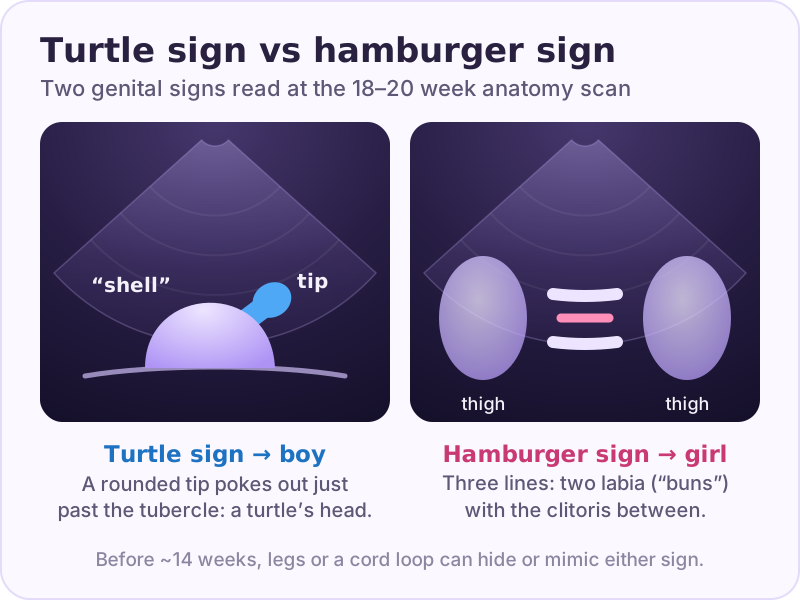
- Potty shot — a clear view between the legs where the genitalia are visible.
- Turtle sign — a small protrusion (the penis) suggesting a boy.
- Three lines / "hamburger" sign — the layered appearance of the labia suggesting a girl.
A good sonographer won't rely on a single glimpse. They'll try to get a clear potty shot from more than one angle, confirm the structure they're seeing isn't the umbilical cord or a hand resting between the legs, and note whether the baby's position allowed a confident view at all. If your sonographer hedges — "it looks like a girl, but baby wasn't cooperating" — that hedge is a feature, not a flaw. It means they're separating what they actually saw from what they suspect, which is exactly how that high reliability is earned in the first place.
Accuracy by gestational age
| Stage | Window | What's read | Reliability |
|---|---|---|---|
| 11 weeks | First trimester | Genital tubercle angle | ~70% overall; 56% of males misread as female (Efrat 1999); pooled sensitivity 69% (Amankona 2025) |
| 12 weeks | First trimester | Genital tubercle angle | ~99% in an expert study (Efrat 1999); pooled sensitivity 89% across studies (Amankona 2025) |
| 13–14 weeks | First trimester | Genital tubercle angle | ~99–100% in expert studies; sex assignable in ~93% at 12–14 wk (Efrat 2006); pooled sensitivity 96% at 13 wk (Amankona 2025) |
| 18–20 weeks | Anatomy scan | Formed genitalia (potty shot, turtle / three-lines) | ~92–99% (study mean–median, Amankona 2025) |
The later and clearer the scan, the more confident the read. Even so, the 18–20-week scan is not perfect — the baby's position is a common remaining source of error.
Why early guesses fail
Before week 11, the genital tubercle is too immature to read at all. The same small bump is present in every fetus regardless of sex — it hasn't yet tilted into a recognisable angle. That's why no scan before 11 weeks can meaningfully suggest sex from the nub, and why reads at exactly 11 weeks carry so much error: the anatomy simply hasn't differentiated yet.
By week 12 the angle starts to emerge, but the window between "just barely visible" and "clearly tilted" is narrow. Small differences in scan quality, image angle, and how far along the pregnancy truly is (a few days matter at this stage) all contribute to whether the tubercle's angle is readable at all. Those factors show up in the numbers: a 2025 meta-analysis of 28 studies found that sensitivity for fetal sex rose from 69% at 11 weeks to 89% at 12 weeks and 96% at 13 weeks, and that was from live scans, not phone photos (Amankona 2025).
Why a scan can still be wrong
Even at 18–20 weeks, ultrasound isn't infallible — and the reasons are almost always physical:
- Position. Crossed legs, a baby facing the spine, or a curled-up pose can hide the genitals entirely.
- Mistaken structures. The umbilical cord or a limb between the legs can be read as a boy by mistake.
- Early timing. The earlier the scan, the higher the error — which is why 11–13-week reads come with caveats.
And not every method that claims to read sex from a scan holds up. Placental-side approaches like Ramzi theory perform at chance in controlled testing, so a scan's value is in what it directly shows, not in folklore overlaid on it. See how the approaches stack up in methods compared.
If your 18–20-week scan couldn't get a clear view — it happens often, and it's nobody's fault — you have options. A follow-up scan a couple of weeks later usually solves a stubborn position, since babies move constantly. Some clinics offer a dedicated growth or "gender" scan in the third trimester as well. The point is that an inconclusive result isn't a dead end; it just means the baby wasn't showing the right view that day, not that the technology failed you.
Confirming sex: what to ask your sonographer
When you're at the 18–20-week scan and hoping for a clear answer, a few specific questions help you understand what the sonographer is actually seeing:
- "Did you get a clear potty shot?" — This tells you whether they had a direct view of the genitalia or were inferring from a partial image.
- "How confident are you?" — A good sonographer will rate their confidence honestly; "pretty sure it's a girl but baby had crossed legs" is a meaningful qualifier.
- "What sign did you see?" — Asking whether they saw the turtle sign or the three-lines sign tells you how direct the evidence was.
- "Should we check again?" — If the view was unclear, a brief wait and repositioning (or a follow-up scan) is a reasonable ask.
A few small things also tilt the odds toward a clear view. Some clinics suggest staying hydrated and arriving with a bit of energy in the baby — a moving baby is more likely to shift into a readable position than a sleepy, curled-up one. If your sonographer can't get a clear potty shot at first, it's reasonable to ask whether a short wait, a quick walk, or repositioning might help. None of this is a magic trick, and a determined baby will hide regardless — but it's worth knowing that an inconclusive scan is usually about the baby's pose, not a limit of the technology.
It also helps to set your own expectations honestly. A 12–13-week nub read is a delightful early hint, and the 18–20-week scan is the reliable confirmation — but even that benchmark (median 99% across studies) leaves a small margin. Treat each scan as one more piece of evidence pointing the same way, and let your doctor's read carry the final weight. That mindset keeps the experience joyful rather than anxious, whichever direction the early guesses lean.
A fun guess before your scan day
Counting down to your anatomy scan? Try the free Chinese gender predictor on our homepage. It's tradition — accuracy is chance-level — but a sweet way to start guessing while you wait for the scan that actually tells you.
First-trimester nub vs anatomy scan: at a glance
| Stage | Window | What's read | Reliability |
|---|---|---|---|
| First-trimester nub | 12–13 wk | Genital tubercle angle (>30°) | Good under ideal conditions; real error, poor at 11 wk |
| Anatomy scan | 18–20 wk | Formed genitalia (potty shot, turtle / three-lines) | Reliable benchmark, ~92–99% across studies |
How BabyPeek fits in
Your scan photos hold the real signal — the trick is reading them right. BabyPeek lets you mark the nub on your actual ultrasound and measures the angle on YOUR image, then runs five methods in total (including a Chinese-calendar guess and other folk predictors) and returns a majority verdict so no single signal runs the show. When you're ready, it turns the result into a shareable gender reveal for the people you love.
Just remember the order of trust: a 12-week nub is a preview, the 18–20-week anatomy scan is the confirmation — and your doctor has the final word.
Dig deeper
- Nub theory explained — the angle of the genital tubercle at 12–13 weeks, how to read it, and honest accuracy.
- Skull theory — brow ridge, jaw shape, and forehead slope on a profile scan.
- Methods compared — how ultrasound, nub, Ramzi, skull and Chinese calendar stack up side by side.
Frequently asked
Sources
- Efrat Z, Akinfenwa OO, Nicolaides KH. First-trimester determination of fetal gender by ultrasound. Ultrasound Obstet Gynecol. 1999;13(5):305–7. PubMed
- Efrat Z, Perri T, Ramati E, Tugendreich D, Meizner I. Fetal gender assignment by first-trimester ultrasound. Ultrasound Obstet Gynecol. 2006;27(6):619–21. PubMed
- Amankona E et al. Effectiveness of prenatal ultrasound in fetal sex identification: a systematic review and meta-analysis. J Ultrasound. 2025. PubMed
Written by the BabyPeek editorial team from the studies above. How we research and write. For entertainment, not medical advice.
For entertainment only. This is not medical advice — confirm your baby's sex with your doctor's anatomy scan.