Turtle sign vs hamburger sign: boy or girl on ultrasound
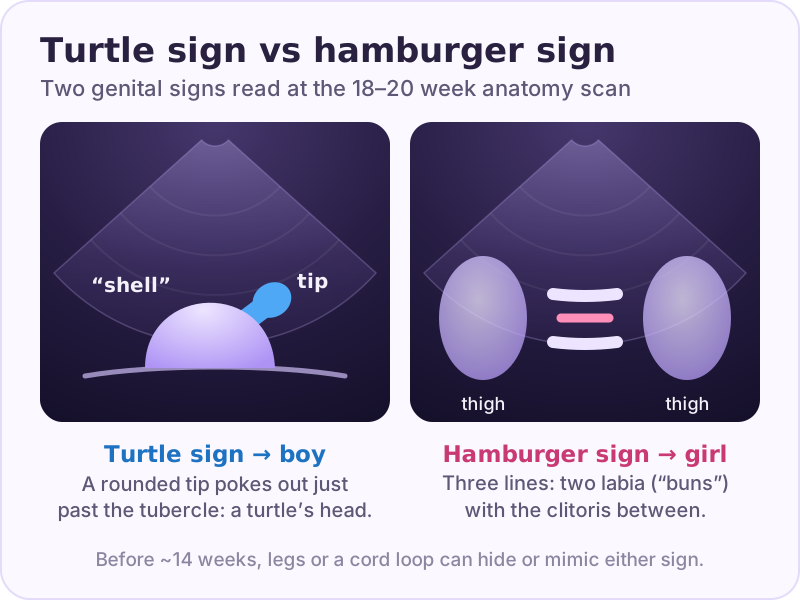
The turtle sign — the tip of the penis peeking out like a turtle's head from its shell — points to a boy. The hamburger sign — the labia forming three parallel lines around the clitoris — points to a girl. Both are real markers sonographers use, and on a clear 18–20-week scan they are about 99% reliable. Earlier than that, they are a fun guess, not an answer.
Quick answer
- Turtle sign = boy: a rounded tip protruding just past the genital tubercle.
- Hamburger sign = girl: three parallel lines (two labia "buns" + clitoris "patty").
- Best timing: the 18–20-week anatomy scan, on a cooperative baby.
- Accuracy: ~99% at 18–20 weeks with a clear view; much lower before ~14 weeks.
- Position is everything — crossed legs or a cord loop can hide or mimic either sign.
What the turtle sign looks like
The turtle sign is one of the most-quoted "it's a boy" markers. On a mid-sagittal (side-on) view of the pelvis, the tip of the developing penis pokes out just beyond the retracting genital tubercle. The rounded tip sitting in front of the body wall genuinely does look like a small turtle's head emerging from a shell — hence the nickname.
It is not folklore in the way Ramzi or skull theory are: sonographers really do use the appearance of the genitalia at the anatomy scan to determine sex. The caveat is timing and clarity. Before the genitals are fully formed, an early "turtle" can just as easily be a swollen clitoris or a loop of umbilical cord catching the light. Read it on the 18–20-week scan, not on a fuzzy 13-week photo.
What the hamburger sign looks like
The hamburger sign — also called the three-line sign or sandwich sign — is the classic "it's a girl" marker. On a transverse (bottom-up) view, the two labia appear as the outer "buns" and the clitoris sits between them as the "patty," creating three roughly parallel white lines. Once you have seen it, it is hard to unsee.
Like the turtle sign, the hamburger sign is a real sonographic feature, not a wives' tale. It becomes clear at the anatomy scan when the labia have developed enough definition. Early on, the same area can look like a nondescript smudge, which is exactly why an 18–20-week scan is the honest place to call it.
Side-by-side
| Marker | Turtle sign (boy) | Hamburger sign (girl) | How much to trust it |
|---|---|---|---|
| What you see | Rounded tip poking out past the tubercle | Three parallel lines (labia + clitoris) | High at 18–20 wk on a clear view |
| Scan plane | Mid-sagittal (side profile) | Transverse (bottom-up) | Critical — wrong plane, wrong read |
| Best timing | 18–20 wk | 18–20 wk | Earlier is unreliable |
| Common false read | Cord loop or swollen clitoris mimics it | Boy with legs crossed looks "flat" | Position resolves most errors |
Why timing matters so much
At 12–14 weeks the external genitalia of boys and girls still look remarkably similar; the same structures that later become a turtle or a hamburger are only just differentiating. That is the same window where nub theory lives, and it is why early gender guesses are exciting but unreliable.
By the 18–20-week anatomy scan, the genitals are formed and — if the baby cooperates — clearly readable. This is when the turtle and hamburger signs earn their roughly 99% accuracy. A shy baby with crossed legs can still foil the view, in which case the honest answer is "we'll try again," not a forced guess.
Got a scan photo? See how the turtle and hamburger signs fit alongside the nub, Ramzi, skull and Chinese methods — and let Peek take a look at your own image.
Read the ultrasound guide →Mistakes people make
- Reading it too early. A 13-week "turtle" is usually wishful — the tissue hasn't separated enough to be sure.
- Ignoring the scan plane. The turtle sign needs a side profile; the hamburger sign needs a bottom-up view. Mixing them up produces confident nonsense.
- Trusting a cord loop. The umbilical cord loves to sit between the legs and impersonate a boy. A sonographer traces it before calling.
- Forgetting swelling. A newborn or late-scan girl clitoris can look prominent; that is normal and not a boy sign.
FAQ
Sources
- Efrat Z, Perri T, Ramati E, Tugendreich D, Meizner I. Fetal gender assignment by first-trimester ultrasound. Ultrasound Obstet Gynecol. 2006;27(6):619–21. PubMed
- Amankona E et al. Effectiveness of prenatal ultrasound in fetal sex identification: a systematic review and meta-analysis. J Ultrasound. 2025. PubMed
Written by the BabyPeek editorial team from the studies above. How we research and write. For entertainment, not medical advice.
How BabyPeek reads your scan
BabyPeek doesn't read the turtle or hamburger sign — that's your sonographer's job. It lets you measure the nub on your own early scan and runs Ramzi, skull, the Chinese calendar and a playful Photo Pick alongside it for a majority verdict — so no single blurry frame gets the final word. When you're ready, it turns the result into a shareable gender reveal.
For entertainment only. This is not medical advice — confirm your baby's sex with your doctor's anatomy scan.