Skull theory boy or girl: the bone markers
Skull theory guesses your baby's sex from the shape of the skull on an ultrasound: a blockier, more angular skull with a heavier brow is read as a boy, and a rounder, smoother skull as a girl. It's a fun game, but be clear-eyed — there is no peer-reviewed evidence that skull shape predicts fetal sex. The features it relies on don't really appear until puberty.
What skull theory claims
The idea is borrowed from forensic anthropology, where adult male and female skulls do differ on average. Skull theory takes those adult traits and applies them to a fetal profile scan, claiming you can sort boy from girl by how angular or rounded the head looks.
The supposed "boy" skull is described as larger, blockier, and more angular; the "girl" skull as smaller, rounder, and smoother. People then study the side-profile ultrasound and tally up which markers they think they see, often scoring two or three "boy" traits against one or two "girl" traits and calling it a verdict.
You'll sometimes see skull theory paired with "Ramzi" or "nub" reads as a kind of stacked guess. That's the fun of it — but stacking an unproven method onto another doesn't add up to a reliable answer, and it's worth knowing which of these games actually has science behind it before you put weight on any of them.
The markers people look for
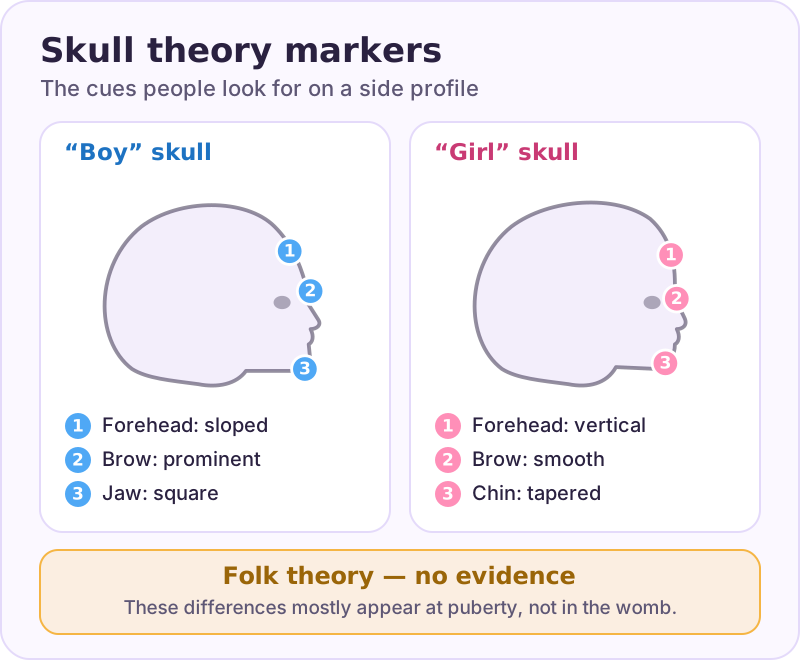
Here are the features skull-theory readers compare. Read this as a list of claims, not facts — none has proven value before birth.
| Skull marker | Boy reading | Girl reading |
|---|---|---|
| Overall shape | Blockier, more angular | Rounder, smoother |
| Brow ridge (above eyes) | More pronounced, heavier | Flatter, less prominent |
| Forehead slope | More sloped / receding | More vertical, rounded |
| Jaw | Squarer, wider, angular | Narrower, more tapered |
| Back of the skull | Flatter, more defined | Rounder, smoother curve |
| General impression | "Heavier," more rugged | "Softer," more delicate |
The trouble is that a profile scan can look very different depending on the baby's angle, the scan plane, and even how the image is cropped. Two people can read the same skull and "see" opposite sexes — which is a strong hint about how much real signal is here.
What the research actually says
This is the part that matters. There is no peer-reviewed scientific evidence that skull or cranial shape on ultrasound predicts a baby's sex. The claims are anecdotal, and they're a textbook case for confirmation bias: once you've decided "that looks like a boy skull," you naturally notice the features that fit and ignore the ones that don't.
There's a deeper biological reason it can't work the way the charts imply: the sexually distinct skull features that forensic anthropologists rely on — the heavier brow, the squarer jaw — largely don't emerge until puberty, driven by sex hormones years after birth. A 12- or 20-week fetal skull simply doesn't carry those adult differences yet.
A fetal medicine specialist has put it plainly: Professor Christoph Lees, Professor of Obstetrics at Imperial College London, has publicly stated there is "no scientific evidence for this theory at all." That absence of evidence isn't a gap waiting to be filled — for skull theory, it is the finding.
It's worth pausing on why the charts feel so convincing anyway. Skull theory borrows real, well-documented differences between adult male and female skulls and quietly assumes those same differences are already present months before birth. They aren't. The brow ridge, the squared jaw, the heavier overall build — these are sculpted by sex hormones during puberty, years after your scan. So when you line a profile ultrasound up against a "boy skull" template, you're matching a fetal head to adult anatomy it hasn't grown into yet. Add in how dramatically a skull's apparent shape shifts with the baby's angle, and almost any scan can be made to "fit" whichever sex you're hoping for. That flexibility is exactly what makes the method fun — and exactly why it predicts nothing.
You may see enthusiasts quote accuracy figures, but no study has measured skull theory at all, so any number is anecdote. It is one of the more subjective methods available, best used as a conversation starter rather than a verdict.
When to trust it — and when not to
If you've held up your profile scan next to a "boy skull vs. girl skull" chart, you're far from alone. Skull theory is one of the most popular gender-guessing games online. Here's the honest picture of when it adds anything at all:
- Use it as light entertainment only. A clear, mid-sagittal profile scan at 12+ weeks gives you the best possible image — but even then, you're reading markers that don't biologically exist in a fetus yet.
- Don't use it as a sole decision. No major medical body endorses skull theory; there is no primary study to cite because none supports it.
- Pair it with other clues if you want a richer story. Skull reads are most useful as one input among several — which is exactly how BabyPeek uses it.
- For a reliable answer, wait for the anatomy scan. The 18–20 week anatomy ultrasound looks at the genitals directly; across studies its accuracy averages about 92%, with a median of 99%.
How to read a skull scan step by step
Use a clear side-profile of the head. Look at three core cues: the brow ridge above the eye socket, the angle of the jaw at the chin, and how the forehead slopes away from vertical.
- 1.Find a true mid-sagittal profile — you should be able to see the spine as a line and the full side of the head.
- 2.Locate the brow ridge just above the eye socket — note whether it projects forward (heavier) or sits flush with the forehead.
- 3.Trace the jaw angle — is the chin squared and wide, or narrower and more tapered?
- 4.Assess the forehead slope — does it lean back from the brow, or rise more vertically?
- 5.Tally up the markers — if two or three cues point in one direction, that's your "read." Remember: it's entertainment, not diagnosis.
Because the markers are subjective, two people often read the same skull differently. Image angle and 2D-vs-3D rendering change the apparent shape dramatically. A blurry or oblique profile leaves so much to interpretation that you're really reading your own hopes, not the skull.
Common mistakes and limitations
- Adult traits, fetal skull. The markers describe grown-up skulls, not unborn ones — the differences simply haven't developed yet.
- Angle changes everything. Tilt the head, change the scan plane, and an "angular" skull turns "round." Two images of the same baby can tell opposite stories.
- Confirmation bias. People remember the hits and forget the misses, making the method feel more accurate than chance.
- No medical recognition. No major body endorses it; there's no primary study to cite because none supports it.
- Image quality varies wildly. A blurry or oblique profile leaves so much to interpretation that you're really reading your own hopes, not the skull.
- Reading from a tilted or front-facing head instead of a clean profile invalidates any read.
- Comparing a 2D image to 3D examples — the rendering changes the shape and makes comparisons meaningless.
If you want an early-scan method that does have peer-reviewed research behind it, look at nub theory — though even that only becomes reliable from about 12–13 weeks. And to see how skull theory ranks against every popular method, our methods compared guide lays them all out honestly.
How BabyPeek handles it
BabyPeek includes skull theory as one of five fun methods — but we're honest that, on its own, it's just for entertainment. The app's value is the majority verdict: it runs several signals together and, crucially, includes a nub-angle measurement on your actual uploaded ultrasound rather than a vibe off a side profile. One method is a coin flip; a cluster of agreeing signals is a more interesting story.
For the reliable answer, the app always points you back to your doctor's 18–20 week scan. In the app, skull cues are just one input — you answer a few questions about the profile, and that vote is counted alongside nub, Ramzi, Chinese and a playful Photo Pick for a single, honest majority verdict.
Try it for fun with BabyPeek
Love the guessing game? BabyPeek lets you run skull theory and four other methods in one place, see where they agree with a majority verdict, and measure the nub on your own real ultrasound — then share a joyful gender reveal. The methods are for fun; the excitement is real.
Frequently asked questions
Sources
No peer-reviewed study has tested skull theory. For how fetal sex is reliably identified on ultrasound, see:
- Amankona E et al. Effectiveness of prenatal ultrasound in fetal sex identification: a systematic review and meta-analysis. J Ultrasound. 2025. PubMed
- Efrat Z, Perri T, Ramati E, Tugendreich D, Meizner I. Fetal gender assignment by first-trimester ultrasound. Ultrasound Obstet Gynecol. 2006;27(6):619–21. PubMed
- Efrat Z, Akinfenwa OO, Nicolaides KH. First-trimester determination of fetal gender by ultrasound. Ultrasound Obstet Gynecol. 1999;13(5):305–7. PubMed
- Lees C, quoted in: "Can skull theory accurately tell your baby's gender?" MadeForMums (expert comment, not a study). Source
Written by the BabyPeek editorial team from the studies above. How we research and write. For entertainment, not medical advice.
Explore other methods
Skull theory is one piece of the puzzle. Compare it with peer-reviewed alternatives:
- Methods compared — how skull theory, nub theory, Ramzi, and more stack up side by side.
- Nub theory — the genital tubercle angle at 12–13 weeks; it has actual peer-reviewed research behind it.
- Ultrasound gender accuracy — the 18–20 week anatomy scan is the gold standard.
For entertainment only. This is not medical advice — confirm your baby's sex with your doctor's anatomy scan.