Ramzi theory: can placenta position predict sex?
Ramzi theory claims that the side of your uterus where the placenta (or early chorionic villi) attaches on a very early ultrasound — around 6 weeks — reveals your baby's sex: right side for a boy, left side for a girl. It's a fun thing to try, but here's the honest part up front: it has never been peer-reviewed, and the one independent study that tested it found no real link. Treat it as entertainment, not an answer.
What Ramzi theory claims
If you've been staring at a 6-week scan trying to spot which side the little flicker of placenta is on, you're in good company. Ramzi is one of the most-searched early-gender guesses online. Let's walk through exactly what it says, where that famous 97% number comes from, and what the actual science shows.
The idea comes from a claim attributed to Saad Ramzi Ismail (often just called "Ramzi"). The argument goes like this: in very early pregnancy, the placenta and its chorionic villi — the tiny finger-like projections that anchor the pregnancy and exchange nutrients — develop on one side of the uterus. According to the theory, the side they favor tracks with the baby's chromosomal sex.
The reported breakdown is strikingly lopsided:
- Placenta / chorionic villi on the right → boy
- Placenta / chorionic villi on the left → girl
The supporting numbers are eye-catching. The claim states that across a large sample, 97.2% of male fetuses had the placenta on the right and 97.5% of female fetuses had it on the left (Ismail ~2011). People then read their own early scans, decide which side the developing placenta sits on, and call the result.
It's easy to see the appeal. A 6-week guess is months ahead of the standard 18–20 week anatomy scan, and "97% accurate" sounds almost diagnostic. But the source of that number matters a great deal.
How people read it
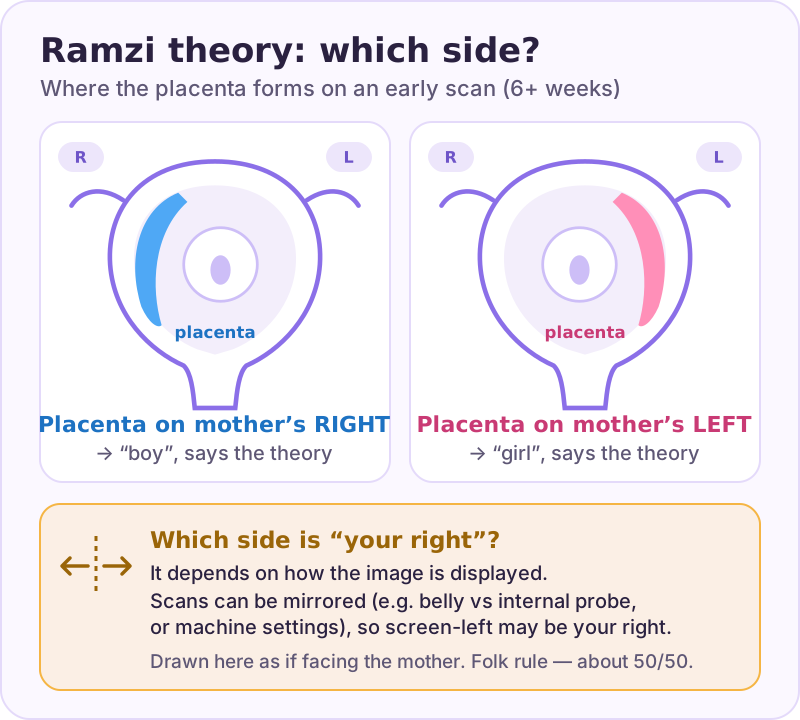
To "do" Ramzi, you need an early scan — usually transvaginal, around 6 weeks — clear enough to show where the brighter placental tissue is forming relative to the midline of the uterus. Enthusiasts look for the side with more developing chorionic villi and assign right-or-left from there.
There's a built-in trap, though: ultrasound images can be mirror-flipped depending on how the scan was taken (transabdominal vs. transvaginal) and how the machine displays it. Read the image the wrong way around and your "right" becomes "left." We cover that flip in detail in our guide to reading Ramzi left or right — it's the single biggest reason two people stare at the same scan and reach opposite conclusions.
What the science actually shows
Now the part that matters most. The 97% figure is the originator's own self-published number — it was posted on the medical website ObGyn.net in 2011, not published in a peer-reviewed medical journal (Ismail ~2011). No major medical body endorses the method.
When independent researchers actually tested whether placental location predicts sex, the result was very different. In a study of 277 fetuses (159 female, 118 male), there was no significant relationship between placental location and fetal sex (χ², P=0.43), and the relative risk of a boy when the placenta sat on the right was just 1.20 with a confidence interval crossing 1.0 (The et al. 2010). In plain English: placental side predicts sex at roughly chance — about a coin flip.
| Source | Sample | What it found | Peer-reviewed? |
|---|---|---|---|
| Ramzi claim (Ismail ~2011) | Claimed thousands of scans | ~97% link between placenta side and sex | No — self-published online |
| The et al. 2010 (independent) | 277 fetuses | No significant link (P=0.43); ~chance | Conference abstract (not a full paper) |
So you have a dramatic, unverified claim on one side and a controlled test showing essentially nothing on the other. That's the whole story.
It's worth understanding why the original number is so hard to trust. The claim describes thousands of women scanned — but the work was never submitted to peer review, where other researchers would check the methods, look for bias, and try to reproduce it. A near-perfect 97% result that no independent team can replicate is a red flag, not a triumph. When a separate group did run a clean test, the link simply wasn't there. That pattern — spectacular self-reported accuracy, nothing on independent replication — is the hallmark of a folk method, not a diagnostic one.
Curious about your own scan? Our Chinese gender predictor gives you an instant, just-for-fun guess in seconds — no early scan required. It's another folk method (also chance-level, and we'll always tell you so), but it's a nice way to play while you wait for the reliable answer.
Common mistakes and limitations
A few things keep Ramzi from being trustworthy even if you love trying it:
- The image flip. As above, transabdominal and transvaginal scans can mirror the picture. Without knowing the orientation, right/left is a guess.
- Early placentas move. What looks like a "side" at 6 weeks can shift as the placenta grows and the uterus changes shape.
- Confirmation bias. Once you've picked a side, it's natural to remember the hits and forget the misses — which makes any folk method feel more accurate than it is.
- No medical endorsement. ACOG, the NHS, and other bodies don't recognize it.
- Trusting a mirrored or flipped image, which reverses left and right.
- Confusing transvaginal and transabdominal orientation.
- Mistaking the cord insertion or a fibroid for the placenta.
- Reading too early, before the placental side is clearly established.
If you want an early scan-based method with actual peer-reviewed research behind it, nub theory is a better bet — though even that only becomes reliable from about 12–13 weeks, not 6. And if you want to weigh Ramzi against every other popular method side by side, see our methods compared breakdown.
How BabyPeek handles it
BabyPeek includes Ramzi as one of five fun prediction methods — but we're upfront that one folk signal alone is a coin flip. The app's real strength is its majority verdict: it runs several methods together and shows you where they agree, including a nub-angle measurement on your actual uploaded ultrasound. One guess is noise; a cluster of signals is a more interesting story. And we never pretend any of it replaces your doctor.
Try it for fun with BabyPeek
Want to play with Ramzi and four other methods in one place? BabyPeek lets you run them all, see the majority verdict, and measure the nub on your own real ultrasound — then share a sweet gender-reveal moment with the people you love. The methods are for fun; the excitement is real.
Frequently asked questions
Sources
- Ismail SR. The relationship between placental location and fetal gender (Ramzi's method). First posted on ObGyn.net, 2011; now hosted by Contemporary OB/GYN (not peer-reviewed). Source
- The S, Chan L. P18.17: The role of placental location assessment in the prediction of fetal gender. Ultrasound Obstet Gynecol. 2010;36(S1):242 (conference abstract, 277 pregnancies). Source
- Amankona E et al. Effectiveness of prenatal ultrasound in fetal sex identification: a systematic review and meta-analysis. J Ultrasound. 2025. PubMed
Written by the BabyPeek editorial team from the studies above. How we research and write. For entertainment, not medical advice.
Sources: Ismail (Ramzi) ~2011 — self-published claim: placenta on the right = 97.2% male, on the left = 97.5% female; never peer-reviewed. The et al. 2010 — Ultrasound Obstet Gynecol 36(S1) P18.17; n=277; no significant relationship between placental location and fetal sex (P=0.43).
For entertainment only. This is not medical advice — confirm your baby's sex with your doctor's anatomy scan.