Skull theory: boy vs girl skull shape
Skull theory says a boy skull looks blockier — a sloped forehead, heavier brow, squarer jaw — and a girl skull looks rounder, with a vertical forehead and tapered jaw. It's a fun profile-scan game, but be honest with yourself: those are adult traits that haven't developed in the womb, so there's no reason to expect it to beat a coin flip — no study has even measured it.
Quick answer
- "Boy" skull: sloped forehead, prominent brow ridge, squarer/blockier jaw.
- "Girl" skull: rounder head, vertical forehead, tapered, softer jaw.
- Where people look: the 12-week side-profile scan (same image as the nub).
- Real accuracy: never measured; no evidence it beats a coin flip. No peer-reviewed evidence supports it.
- Why: fetal skulls haven't developed adult sex differences.
The markers people use
Skull theory borrows from forensic anthropology, where adult male and female skulls really do differ on average. Guessers apply those same cues to a fetal profile:
- Forehead: a sloped, receding forehead is read as boy; a tall, vertical one as girl.
- Brow ridge: a heavier, more prominent brow leans boy; a smoother brow leans girl.
- Jaw and chin: a squarer, blockier jaw is called boy; a narrower, tapered jaw is called girl.
- Overall shape: a boxier cranium reads boy; a rounder one reads girl.
Boy vs girl: side by side
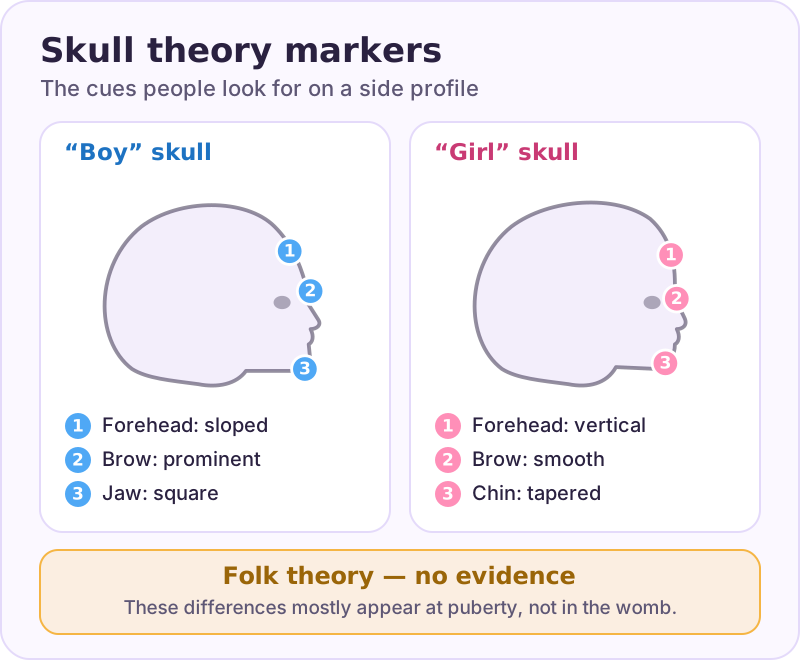
| Marker | "Boy" skull | "Girl" skull | How much to trust it |
|---|---|---|---|
| Forehead | Sloped, receding | Tall, vertical | Low — not developed in utero |
| Brow ridge | Prominent | Smooth | Low — an adult trait |
| Jaw | Square, blocky | Tapered, narrow | Low — subjective on a scan |
| Overall | Boxier | Rounder | Low — angle-dependent |
Notice the whole right column: "how much to trust it" is low across the board. That's the honest picture.
Why the accuracy is basically a coin flip
The sex differences that make adult skulls distinguishable — brow ridge, jaw robustness — are driven largely by puberty, years after birth. At 12 weeks a fetal skull hasn't developed them, so the "boy" and "girl" markers you're reading are mostly a product of the scan angle, the baby's position, and what you're hoping to see.
There is no peer-reviewed study showing fetal skull shape predicts sex. When something has two outcomes and no real signal, it lands right at 50%. Skull theory guesses that "come true" are simply the half that were always going to. Compare it against the methods that at least have a measurable basis on the methods compared page.
Want a marker with an actual measurement behind it? Nub theory reads the genital tubercle angle — a validated cue, unlike skull shape.
See nub theory →How to enjoy skull theory without fooling yourself
- Treat it as a game. It's a fun way to pass the wait between scans — just don't paint the nursery on it.
- Watch confirmation bias. If you already have a hunch, you'll read the skull to match it. Ask a neutral friend.
- Don't stack a guess on a guess. A blurry profile plus a subjective marker equals two layers of uncertainty.
- Confirm the real way. The 18–20-week anatomy scan is the reliable answer — see how to tell gender from ultrasound.
FAQ
Sources
No peer-reviewed study has tested skull theory. For how fetal sex is reliably identified on ultrasound, see:
- Amankona E et al. Effectiveness of prenatal ultrasound in fetal sex identification: a systematic review and meta-analysis. J Ultrasound. 2025. PubMed
- Efrat Z, Perri T, Ramati E, Tugendreich D, Meizner I. Fetal gender assignment by first-trimester ultrasound. Ultrasound Obstet Gynecol. 2006;27(6):619–21. PubMed
Written by the BabyPeek editorial team from the studies above. How we research and write. For entertainment, not medical advice.
Don't bet on one guess
BabyPeek doesn't rest on skull shape alone. It counts your skull read together with the nub, Ramzi, Chinese calendar and a playful Photo Pick for a majority verdict, so a single subjective read never decides it — plus a shareable reveal when you're ready.
For entertainment only. This is not medical advice — confirm your baby's sex with your doctor's anatomy scan.