Ramzi theory left or right: which side means boy and which means girl?
In Ramzi theory, a placenta on the right side of your uterus is said to mean a boy, and on the left a girl — read off an early ultrasound around 6 weeks. It is fun to try, but it is not reliable: ultrasound images can be mirror-flipped, which flips your answer, and controlled research found placenta side predicts sex at roughly chance.
The quick answer
- Right = boy, left = girl — the core Ramzi claim.
- Mirror-flip warning: many scans display left and right in reverse, so your read can be entirely backwards.
- Honest accuracy: ~50% — no better than a coin flip in controlled testing.
The right = boy, left = girl rule
The whole left-or-right question rests on a simple claimed rule:
- Placenta / chorionic villi on the right → boy
- Placenta / chorionic villi on the left → girl
The original claim put dramatic numbers on it — 97.2% of boys with the placenta on the right, 97.5% of girls on the left (Ismail ~2011). To apply it, you look at an early scan, find the side where the brighter, thicker placental tissue is developing relative to the uterus's midline, and assign boy or girl accordingly.
Sounds simple. The complication is that "right" and "left" on an ultrasound are not always what they look like. For the full background on where this theory comes from, see our main Ramzi theory explained guide.
The mirror-flip problem
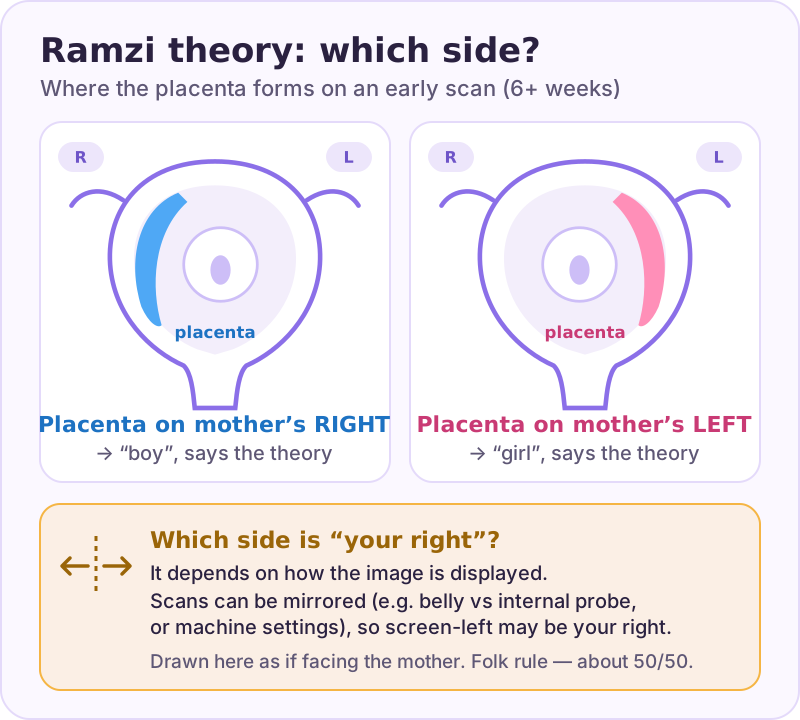
Here is the single most important thing to understand: an ultrasound image can be mirror-flipped, so the baby's true right can appear on the left of your screen and vice versa.
Transabdominal vs transvaginal — the image flip
This happens because of how the scan was taken:
- A transabdominal scan (probe on the belly) and a transvaginal scan (internal probe) can produce images with opposite left-right orientation.
- Machines and sonographers do not all label or flip the picture the same way.
Ramzi readers often use a rough rule of thumb — treat transabdominal images as mirrored and transvaginal as true — but this is not a medical standard. If you guess the orientation wrong, your "right" becomes "left" and your boy becomes a girl. Two people can read the exact same scan and confidently reach opposite answers, purely because of the flip.
| What you see / do | Effect on the prediction |
|---|---|
| Read the scan without checking transabdominal vs. transvaginal | Result may be reversed — coin flip |
| Assume the on-screen left is the baby's left | Often wrong; images are frequently mirrored |
| Use a 6-week scan where the placenta is still forming | Side can shift as the placenta grows |
| Decide the side after you already have a hunch | Confirmation bias inflates "accuracy" |
That fragility — where one orientation question flips the whole result — is a clue about how much real signal is here.
How to know if your scan is flipped
Check the scan type label, if your image has one. As a rough guide that Ramzi readers use:
- Transabdominal scans are often treated as mirror-reversed — so what appears on screen-right may be the baby's left.
- Transvaginal scans are often treated as true-orientation — what is on screen-right is the baby's right.
This is not a standardized rule — it is a community heuristic that varies by machine, clinic, and operator settings. Without a definitive label from your sonographer, you cannot be certain which way your image is oriented. That ambiguity alone is enough to flip your Ramzi result.
Want an instant guess without decoding an ultrasound? Try our Chinese gender predictor on the homepage — a folk method too, but there is no left-or-right to get wrong.
Try the gender predictor →Step-by-step reading guide
If you still want to try reading placenta side, here is how most Ramzi readers do it:
- Identify the scan type. Is it transabdominal or transvaginal? Note it before anything else.
- Orient the image. If transabdominal, treat it as mirrored (screen-left = baby's right). If transvaginal, treat it as true.
- Find the gestational sac and placenta. Look for the brighter, denser area of tissue.
- Locate the uterine midline. The placenta should favor one side of this line.
- Apply the rule. Placenta on baby's right → boy. Placenta on baby's left → girl.
Keep in mind: even if you execute every step perfectly, the underlying association between placenta side and fetal sex does not hold up in controlled research (see below).
What if the placenta is central or posterior?
Not every scan gives you a clear left or right. Sometimes the placenta is:
- Central / fundal — sitting at the top of the uterus without a strong left or right lean. Ramzi theory offers no clear prediction here.
- Posterior — against the back wall of the uterus. Side is harder to judge and the signal is even weaker.
- Still forming — at 6 weeks the chorionic villi are spreading; a side that looks left at 6 weeks can look central by 8 weeks as implantation evolves.
In any of these cases, most Ramzi readers simply call the result inconclusive. That honestly is the right call — there is no reliable signal to read.
Why the rule is ~50% accurate
When researchers tested whether placental location actually relates to fetal sex, the answer was no. In a study of 277 fetuses (159 female, 118 male), there was no significant relationship between placental location and fetal sex (P=0.43); the relative risk of a boy with a right-sided placenta was just 1.20, with a confidence interval that includes 1.0 — meaning no reliable effect (The et al. 2010).
So even if you nail the left-or-right reading perfectly and avoid the flip, the underlying link the method depends on does not hold up in controlled testing. Placenta side predicts sex at roughly chance, about 50%.
It helps to picture why the left-or-right question is so shaky. A 6-week placenta is not a fixed landmark — it is tissue that is still spreading and settling as the uterus grows. So even the "side" you are reading can change between scans. Layer the mirror-flip problem on top of a moving target, and you can see why two careful readers, both following the rule correctly, can still land on opposite answers. That is not a flaw in how you read it — it is a flaw in the method itself.
Want to see how placenta-reading stacks up against nub, skull, and the Chinese calendar? Our methods compared table lines them all up honestly — and shows why a single coin-flip signal matters far less than several methods agreeing.
What's actually reliable
If you want a dependable answer, timing beats theory. The reliable benchmark is the 18–20 week anatomy scan, when the genitals are fully formed — across studies, accuracy averages about 92% with a median of 99% (Amankona 2025). Our ultrasound gender guide walks through what is visible at each stage and why the baby's position is a common source of error at that point.
Early scans can suggest sex but carry real error. If you want the most honest early signal, methods like nub theory at 12–13 weeks perform better than Ramzi — and even then, a single method is far from definitive.
How BabyPeek handles it
Inside BabyPeek, Ramzi is one of five fun methods — and because a single coin-flip method is not much to go on, the app shows you a majority verdict across several signals, including a nub-angle measurement on your own real ultrasound. You still choose the placenta side yourself, so the flip problem applies in the app too — which is exactly why Ramzi is only one vote of five. It is a friendlier, more honest way to play while you wait for your doctor's scan.
FAQ
Sources
- Ismail SR. The relationship between placental location and fetal gender (Ramzi's method). First posted on ObGyn.net, 2011; now hosted by Contemporary OB/GYN (not peer-reviewed). Source
- The S, Chan L. P18.17: The role of placental location assessment in the prediction of fetal gender. Ultrasound Obstet Gynecol. 2010;36(S1):242 (conference abstract, 277 pregnancies). Source
- Amankona E et al. Effectiveness of prenatal ultrasound in fetal sex identification: a systematic review and meta-analysis. J Ultrasound. 2025. PubMed
Written by the BabyPeek editorial team from the studies above. How we research and write. For entertainment, not medical advice.
Skip the left-or-right headache
BabyPeek runs five gender-prediction methods, shows you the majority verdict, including a nub-angle measurement on your own ultrasound — then turns the moment into a shareable gender reveal. Download BabyPeek and start guessing.
For entertainment only. This is not medical advice — confirm your baby's sex with your doctor's anatomy scan.
Sources: Ismail (Ramzi) ~2011 — self-published claim; never peer-reviewed. The et al. 2010 — Ultrasound Obstet Gynecol 36(S1) P18.17; n=277; no significant relationship between placental location and fetal sex (P=0.43).